You hear it, but miss the meaning
Understand the whole phrase.
Connect phrasal verbs to familiar situations, so you can see what the speaker means in that context.
English Master Course
Understand what you hear.Practice what you want to say.
Move beyond looking up meanings. Learn phrasal verbs through everyday situations, then use them in matching conversations and practical role plays.
Study at your pace · Lessons taught in English
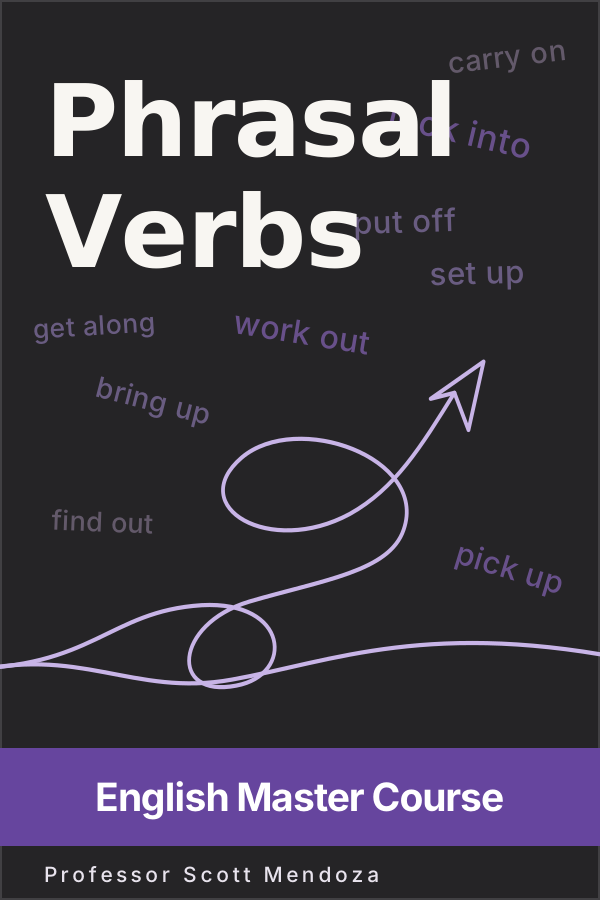 Learn the phrase. Hear it. Use it.
Why this course
Knowing “turn” and “down” does not always tell you what “turn down” means. Learn the whole phrase, then practice using it.
You hear it, but miss the meaning
Connect phrasal verbs to familiar situations, so you can see what the speaker means in that context.
You know it, but mix up the order
Work with verb forms, objects and pronouns. Learn when words can move and when they need to stay together.
You recognize it, but rarely use it
Hear complete conversations, rehearse useful lines and take a supported speaking role. Then try your own replies.
Sample exercise
Try the idea with “turn down.” Read each sentence and notice how the situation changes the meaning.
Please turn down the music.
Make the music quieter.
Same phrasal verb. The context tells you which meaning fits.
Each vocabulary lesson teaches eight related phrasal verbs. Its matching conversation lesson gives you three complete conversations to listen to and practice.
Study eight related phrasal verbs through meanings, examples and practice.
The matching lesson has three complete conversations. Hear the phrases in context and follow what each speaker means.
Repeat useful lines, then take one side with on-screen support and pauses for your replies.
Try your own responses in an AI role play, answer quiz questions and complete the worksheet practice.
Explore the course
Begin with the grammar: verb forms, objects, separability, pronoun placement and two-particle phrasal verbs. Then explore these situations.
Included with your course
Put the lesson to work, check your understanding and come back to the parts you need.
Print them or type into the fillable PDFs. Complete listening gaps, speaking lines and post-video practice.
Check meanings and patterns with quizzes. Separate answer keys cover the post-video worksheet practice.
Use the phrasal verbs in practical exchanges with an AI character. A microphone is needed for spoken practice.
Bring questions about meanings, grammar or a lesson to the course discussion on Udemy.
How it fits
The flagship introduces phrasal verbs as part of its wider grammar course. This course gives them sustained practice through related vocabulary sets, complete conversations and practical role plays. You can take it on its own if you understand basic English.
 Available on UdemyEnglish Grammar and English SpeakingExplore this course
 Good to know
Yes. Phrasal Verbs is available on Udemy. See the full course and enrollment details
You should understand basic English sentences and be able to follow lessons taught in English. You do not need to know phrasal verbs already. Be ready to pause, speak aloud and try your own answers.
No. You can take Phrasal Verbs on its own. It begins with the grammar you need for this topic. The Grammar and Speaking course is useful if you want broader support with English.
Print the worksheets or complete the fillable PDFs in a compatible PDF reader. Listening gaps are answered in the videos. Separate answer-key files in Section 1, Lecture 3 cover the post-video practice; your personal responses will vary.
No. You practice with an AI character in a practical situation. Spoken AI role plays need a microphone. The recorded conversation lessons also let you listen, repeat and practice a speaking role at your own pace.
Enrollment and lessons are on Udemy. Use the course link to see the full curriculum and enrollment details.
The Lab is a separate speaking-practice community in development and is not open yet. A Udemy course purchase does not enroll you in it. Explore the planned Lab