Grammar · Free lesson
May and might: possible, but not certain
Lena has not confirmed her plans. You want to tell your friends she could join the group without making a promise for her.
 Professor Scott Mendoza
The short answer
May and might can both say that something is possible but not certain: Lena may join us; Lena might join us. Follow them with the base form, without to or an extra s. With be, use may be or might be, not may is.
A possibility is not a confirmation.
May and might leave the outcome open. In these examples, either works; do not memorize a fixed percentage for each word. The modal stays the same with I, she or they, and the next verb is the base form: might join, may be. A time phrase tells us whether we mean now or later.
Keep the outcome open
Lena may join us after work.
Lena might join us after work.
The café might be closed now.
The café might be closed now is a present guess. Might does not automatically make a sentence past tense.
Build one cautious update
Name the person
Lena
Show uncertainty
might
Use the base verb and add the time
join us after work.
Try it now
Keep the grammar and uncertainty.
Read all answers and explanations
Lena has not confirmed. Choose the correctly formed sentence with might.
Lena might join us.After might, use the base form join. Do not add third-person s or to.
What does “Lena may join us after work” mean in this unconfirmed-plan context?
It is possible that Lena will join us, but it is not certain.It describes a possible plan, not a definite promise or definite inability.
You do not know whether the café is open. Choose the correct may + be sentence.
The café may be closed.May is unchanged and is followed by the base form be: may be closed.
Put it into practice
Correct the update without promising too much.
Keep Lena’s plan uncertain and keep after work. Repair the verb after might.
Lena might to join us after work.
See a model answer
Lena might join us after work.
The repaired sentence is still cautious. Correcting the grammar does not turn Lena’s possible plan into a promise.
A little more clarity
Common questions
A few useful details before you move on.
Does might always refer to the past?
No. Here it can describe uncertainty about now or a future time. The context and time phrase help locate the event.
We might visit the park tomorrow.
Is may exactly 50% and might exactly 30%?
No. They do not assign fixed numerical probabilities. Context and tone affect how tentative the speaker sounds; both can work in the examples here.
Lena may join us. Lena might join us.
Take it into your day
May or might + base verb expresses a possibility without a guarantee.
Your next step · Available on Udemy
Say what you mean with more control.
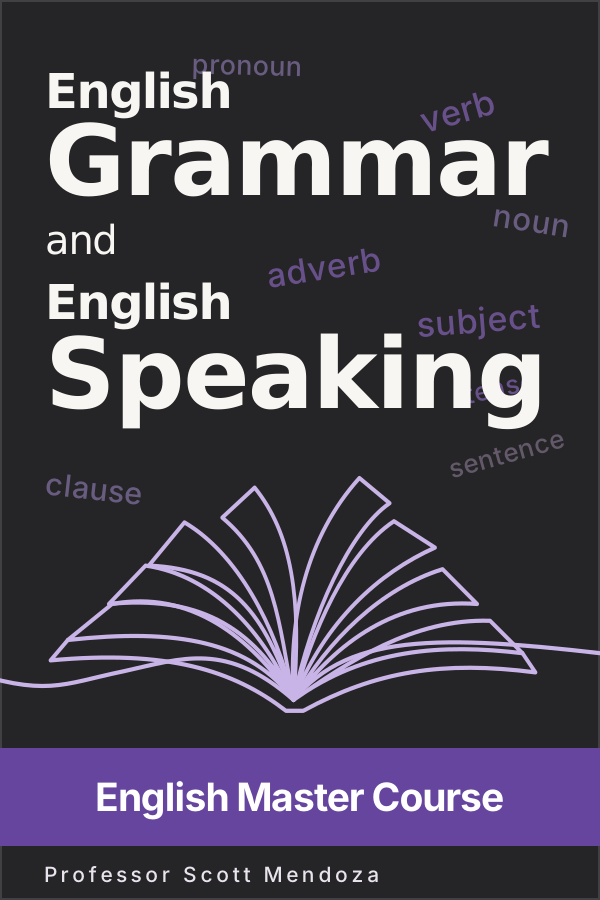
The English Grammar and English Speaking course includes a Must, May, Might section with Learn it, Review it, Use it and Practice it, plus a modal-verb speaking role play. This page gives you one practical part of that wider work.
Explore the course English Master Course: English Grammar and English Speaking