Grammar · Free lesson
I teach or I’m teaching? Usual and temporary activities
Your regular subject is history. The art teacher is away for one week, and you are covering those classes. You need to explain both your usual work and this temporary change.
 Professor Scott Mendoza
Meaning in this lesson
present simple and present continuous
Two forms that can distinguish a usual activity from an activity in progress or a temporary current situation.
Example
“I usually teach history, but this week I’m teaching art.”
History is my regular subject. Art is a temporary assignment this week.
The short answer
Use the present simple for a usual activity: “I teach history.” Use am, is or are plus an -ing form for an activity in progress or a temporary current arrangement: “I’m teaching art this week.” The time phrase helps explain the situation; it does not choose the tense by itself.
Show what is usual and what is temporary.
The present simple can describe a routine: I teach, she teaches. The present continuous uses a form of be and an -ing verb: I am teaching, she is teaching, they are teaching. A current activity can extend over days or weeks. It does not have to be happening at the exact second you speak.
Explain the temporary change.
Are you an art teacher now?
I usually teach history. I’m teaching art while Rosa is away this week.
Usually teach describes the regular job. Am teaching describes the limited current assignment.
Build the contrast
Describe the usual activity
I usually teach history.
Add the temporary activity
I’m teaching art this week.
Keep the helping verb
Say I am teaching, not I teaching.
Try it now
Check what you’ve learned.
Read all answers and explanations
Choose the present simple sentence that describes Sara’s regular teaching job.
Sara teaches music.Teaches is present simple and can describe Sara’s regular job. The other forms describe past or future time.
Complete the present continuous form: “They ___ in the smaller classroom this week.”
are studyingThey takes are, followed by the -ing form studying. Both parts are needed.
“I’m reading a long novel this month.” Does this necessarily mean the book is open right now?
No, it can describe an activity in progress over the current period.The activity has started and is in progress over the current period, but it can pause; the book need not be open at this second.
Put it into practice
Repair the temporary-work update.
History is your usual subject. Your temporary art assignment is happening this week. Add the missing helping verb and keep both facts.
I usually teach history, but this week I teaching art.
See a model answer
I usually teach history, but this week I am teaching art.
A good correction repairs the form without moving the event to a different time or changing the regular job.
A little more clarity
Common questions
A few useful details before you move on.
Does the present simple mean something can never change?
No. It presents something as a routine, fact or usual situation. Your routine can change later.
“I work at a museum.” does not mean you must keep that job forever.
Does now always mean I need the present continuous?
No. Consider the verb and meaning as well as the time word. With know describing your current knowledge, the simple form is normal.
“I know the answer now.”
Take it into your day
Ask what you want to show: the regular situation or an activity happening around now. Then check the complete verb form.
Your next step · Available on Udemy
Choose verb forms with a clearer purpose.
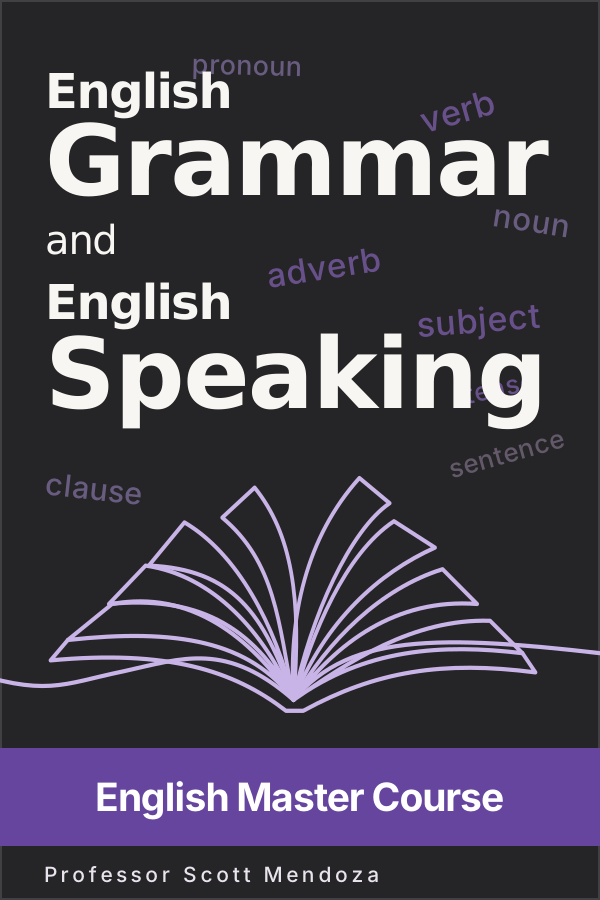
You’ve compared a routine with a temporary situation. The English Grammar and English Speaking course develops a broader tense foundation and connects grammar explanations with conversations, quizzes and practice materials.
Explore the course English Master Course: English Grammar and English Speaking