Grammar · Free lesson
Since or for? A starting point or a length of time
You started a job earlier and still work there. You can name the starting date or say how long you have worked there.
 Professor Scott Mendoza
The short answer
Use since for a past starting point: since Monday. Use for for a length of time: for three days. For a situation that started earlier and still continues, a present-perfect sentence can use either, with the right time phrase.
Look at the kind of time information.
A starting point answers “When did it begin?” A duration answers “How long?” In “I have worked here since April,” April is the starting point. In “I have worked here for six months,” six months is the duration. Have worked is a present-perfect form: have plus worked, the past participle. The time phrase follows since or for.
Two ways to describe continuing time.
I have lived in this apartment since 2021.
I have lived in this apartment for several years.
Both sentences describe a situation continuing now. The first names when it began; the second gives its length without calculating an exact number of years.
Choose the time phrase
Find the time information
Is it a date or a length such as two weeks?
Choose since or for
Since a starting point; for a duration.
Check the whole sentence
Does the situation still continue, or is it a finished event?
Try it now
Check what you’ve learned.
Read all answers and explanations
Complete: “I have had this bike ___ 2022.”
since2022 identifies the starting point, so since fits this continuing ownership.
Complete: “We have been here ___ two hours.”
forTwo hours is a length of time. Use for.
Which statement about for is accurate?
For can introduce a duration with different tenses.A duration can belong to a finished past event, a continuing situation or a future plan.
Put it into practice
Keep the duration. Repair the time word.
Keep the present-perfect form and the same length of time. Change only the word before six years.
I have worked here since six years.
See a model answer
I have worked here for six years.
You repaired the time relationship without changing the duration or the sentence’s focus.
A little more clarity
Common questions
A few useful details before you move on.
Can since introduce an event instead of a date?
Yes. An event can identify the starting point. Keep the meaning clear: that event tells us when the situation began.
“I have known her since we started school.”
Can I use for with the past simple?
Yes. For can measure a finished period as well as a continuing one. The sentence tells us which is intended.
“We rented that apartment for eight months, then moved.”
Take it into your day
Describe something that is still true in your life. Give its starting point with since or its duration with for.
Your next step · Available on Udemy
Make more tense and time choices with confidence.
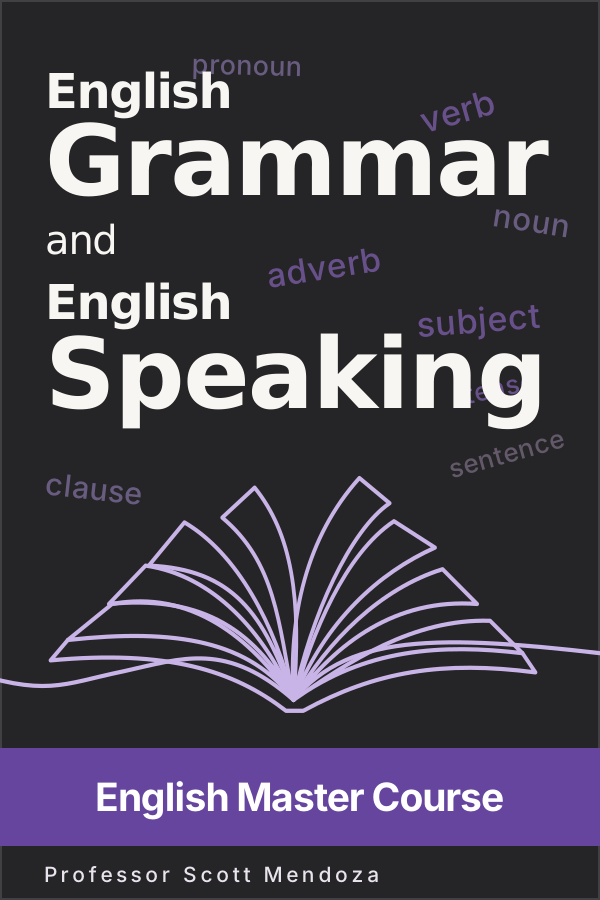
You’ve separated a starting point from a duration. The English Grammar and English Speaking course develops the wider tense and sentence patterns through explanations, conversations, quizzes and practice materials.
Explore the course English Master Course: English Grammar and English Speaking