Speaking · Free lesson
Clarify a web feature: who changes, and for how long?
“Add a theme switch” sounds simple. But should one person’s choice change everyone’s screen? Should the choice still apply tomorrow?
 Professor Scott Mendoza
The short answer
Ask “Should this affect only the current user or everyone?” for scope. Ask “Should we remember the choice for future visits?” for persistence. A visible change now does not by itself answer either question.
Ask about the behavior before promising the build.
Only the current user limits who is affected. For future visits says the preference should remain beyond this visit. These phrases describe the intended experience; they do not decide where or how the data will be stored.
Two questions that remove ambiguity
Should this affect only the current user or everyone?
Should we remember the choice for future visits?
Current user means the person using it now. Every user describes a much wider scope.
Confirm the request in two parts
Clarify who
Is this a personal preference or a setting for everyone?
Clarify duration
Should it stay saved when the user returns?
Try it now
Ask for the missing requirement
Read all answers and explanations
Which question clarifies user scope?
Should this affect only the current user or everyone?This asks whose experience should change, not the visual detail or meeting time.
Which question asks about persistence?
Should we remember the choice for future visits?Remember for future visits asks whether the choice should remain after this visit.
The manager says the preference is personal and saved. Which summary fits?
Each user’s own choice remains saved for later visits.This preserves both the individual scope and the saved behavior.
Put it into practice
Clarify a display preference
The product manager asks for a theme switch. Confirm who it affects and whether the choice should remain on later visits.
- Product manager
Let users choose a dark theme.
See a model answer
- Product manager
Let users choose a dark theme.
- You
Should this change only the current user’s theme or everyone’s theme?
- Product manager
Only the current user’s theme.
- You
Should we remember the choice when that user returns?
- Product manager
Yes. Keep their choice for future visits.
Who does it affect? and Should it remain saved? clarify behavior before anyone chooses an implementation.
A little more clarity
Common questions
A few useful details before you move on.
Is “Do you mean…?” useful here?
Yes. Offer a concrete interpretation and invite correction. Avoid a vague “Do you mean the thing?” that leaves the same ambiguity.
Do you mean a personal setting that stays saved for the next visit?
Can I ask about users and saved settings in one question?
Yes, if the question stays easy to answer. You can also confirm one point at a time: who the change affects, then whether it stays saved. Use a short recap to check that both answers match your understanding.
Take it into your day
A shared understanding of behavior comes before a confident promise.
English for Careers · Coming Soon
Connect browser, server and team conversations.
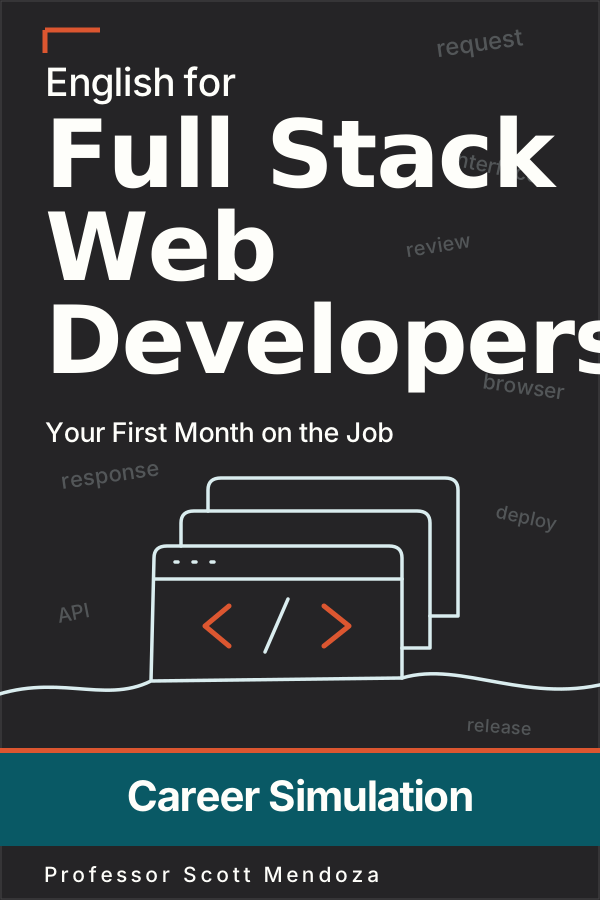
English for Full Stack Web Developers: Career Simulation is coming soon, with planned practice around a connected web-product release.
Get launch updatesFull Stack Web Developers · Career Simulation
Your next step · Available on Udemy
Build clearer sentences for work.
The available English Grammar and English Speaking Master Course develops sentence-building, vocabulary and business-communication foundations. It is a broader English course, not this specialist career simulation.
Explore the course English Master Course: English Grammar and English Speaking