Grammar · Free lesson
How to make English sentences clearer
When a sentence carries too many ideas, the reader has to do extra work. Give each idea a clear structure.
 Professor Scott Mendoza
The short answer
When several ideas are joined with “and,” check whether a full stop would help. Keep the subject clear in each new sentence, and make vague words more specific.
Make it easy to follow the thought.
Start with who did what. The subject tells the reader who or what the sentence is about; the verb tells what happens or describes a state. When you split a statement, check that each new sentence can stand on its own. Keep the important facts, and make words such as “she,” “it” or “some” clear from the context. Separating ideas helps only if the reader can still follow the meaning.
Give the ideas some space.
The meeting was long and there were lots of points and I forgot some.
The long meeting covered a lot of points. I forgot some of the details.
The revision keeps the long meeting, the many points and the forgotten information. “Some of the details” makes “some” clearer. The first version is understandable; the revision gives the reader an easier path through the same facts.
Read it with three questions
Who or what?
Is the subject clear?
What happened?
Can the reader find the main action?
What comes next?
Would a new sentence help?
Try it now
Make the meaning easier to follow.
Read all answers and explanations
Which version makes it clear that Maya sent the file?
Maya spoke to Jo. Maya sent the file.Repeating “Maya” removes the uncertainty. In the first version, “she” could refer to Maya or Jo.
Split this into two complete sentences: “I opened the email and I read the instructions.”
I opened the email. I read the instructions.The last version preserves both actions and makes “I” the subject of each sentence. “Read the instructions” on its own would usually be an instruction to the reader.
Which sentence tells us exactly what was missing?
Two pages were missing from the report.Two pages identifies exactly what was missing. Some things and a few parts leave that information unclear.
Put it into practice
Make an edit that keeps the meaning.
Keep all three facts: you called Maya, she was busy, and she said she would call later. Choose a revision with two complete sentences.
I called Maya and she was busy and she said she would call later.
See a model answer
I called Maya, but she was busy. She said she would call later.
This is one useful revision, not the only way to express these facts. It meets our goal: two complete sentences with all three facts preserved.
A little more clarity
Common questions
A few useful details before you move on.
Is every long sentence a run-on sentence?
No. A run-on joins complete clauses without the punctuation or connection they need. Length alone does not make a sentence wrong. A long sentence can be clear, and a short sentence can still contain a joining error.
“I called Maya she answered.” needs a boundary: “I called Maya. She answered.”
Should I always replace pronouns with names?
No. Pronouns help you avoid unnecessary repetition when the reference is clear. Repeat the name when two possible people or things make the meaning uncertain.
“Maya arrived late. She apologized.” is clear: “she” refers to Maya.
Are a period and a full stop the same thing?
Yes. Both names refer to the punctuation mark at the end of a statement. “Period” is usual in American English; “full stop” is usual in British English. After it, start the next sentence with a capital letter.
Take it into your day
Read one message before you send it. Look for a place where a new sentence would make it easier to follow.
Your next step · Available on Udemy
Build sentences you can use with confidence.
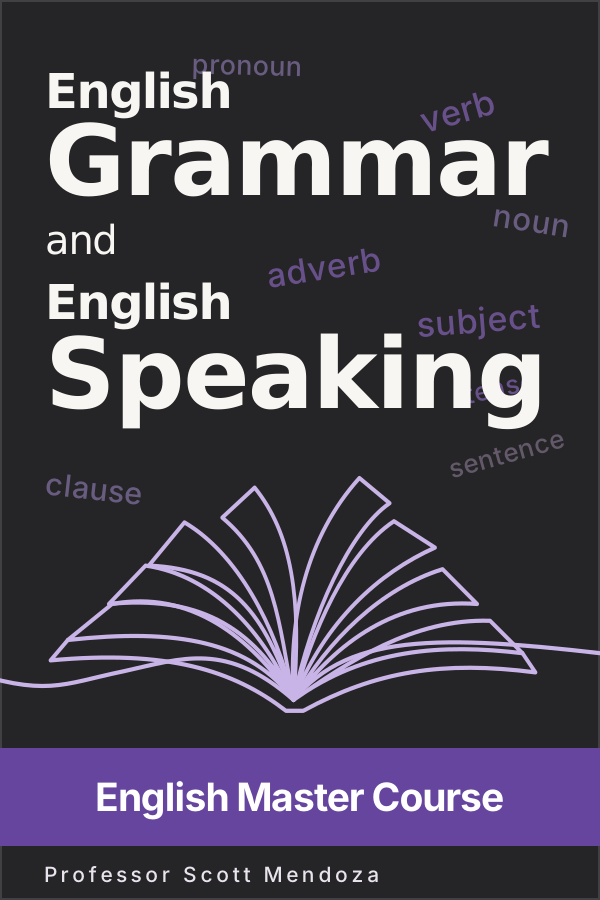
You’ve made one message easier to follow. Develop the grammar behind clear speaking and writing through the English Grammar and English Speaking course, with sentence explanations, punctuation lessons, quizzes and practice materials.
Explore the course English Master Course: English Grammar and English Speaking