Phrasal verbs · Free lesson
“Put it off” or “put off it”?
Learn what “put off” means, then practice putting the words in the right order.
 Professor Scott Mendoza
Meaning in this lesson
put off
To delay or postpone something: do it at a later time.
Example
“We put off the meeting until Friday.”
The meeting will happen later, on Friday.
The short answer
Say “put it off.” When “put off” means postpone, a pronoun such as “it” goes between “put” and “off.” With a short noun phrase, both “put off the meeting” and “put the meeting off” work.
A noun gives you two choices. A pronoun goes in the middle.
The object is the thing you are postponing, such as “the meeting.” With “put off” in this meaning, a short noun phrase can go after both words or between them. That is why we call it separable. A pronoun replaces the noun phrase: use “it” for one meeting or “them” for several meetings. These pronouns go between “put” and “off.”
Same plan. Three correct sentences.
We put off the meeting until Monday.
We put the meeting off until Monday.
We put it off until Monday.
The meeting is happening later in all three examples. “It” refers to the meeting. “We put off it” is not the standard word order for this meaning.
Make the change in three steps
Find the object
What are you postponing? Here, it is the meeting.
Choose the wording
You can name the meeting again, or refer back to it with “it.”
Place the pronoun
If you use “it,” place it in the middle: put + it + off.
Try it now
Where does the object go?
Read all answers and explanations
The appointment is now on Friday. Which sentence uses “it” correctly?
We put it off until Friday.“It” replaces “the appointment.” With “put off” in this meaning, the pronoun belongs between the verb and “off.”
Which statement about these sentences is correct? “They put off the trip.” “They put the trip off.”
Both sentences are correct.“The trip” is a short noun phrase. It can go after “put off” or between the two words. Both sentences mean they delayed the trip.
Replace “the interviews” with “them”: “We put off the interviews.”
We put them off.“Them” is a pronoun, just like “it.” It goes in the middle: “put them off.” Changing a noun to a pronoun changes which word order you can use.
Build it yourself
Build the reply.
Your picnic was planned for Saturday, but the forecast is bad. Suggest moving it to Sunday. Use “it” to refer to the picnic.
Choose the pieces in order to build your sentence. Select a piece again to move it back.
Your sentence
0 of 5 piecesYour chosen pieces will appear here.
See a model answer
Let’s put it off until Sunday.
“It” replaces “the picnic” and goes between “put” and “off.” “Until Sunday” tells us the new time.
A little more clarity
Common questions
A few useful details before you move on.
Does “put off” mean cancel?
In the meaning taught here, “put off” means postpone: the plan moves to a later time. Canceling means the planned event will not take place as arranged. If you are moving an appointment to another day, “put off” expresses that delay.
“We put the appointment off until Tuesday.” The appointment is now planned for Tuesday.
What is the past tense of “put off”?
The past tense is also “put off.” “Put” has the same form in the present and the simple past, so the context or a time phrase shows when the action happened. A pronoun still goes in the middle.
“Yesterday, we put it off until next week.”
Can I say “put off calling someone”?
Yes. When the thing you are postponing is an activity, you can use an -ing form after “put off.” Use “calling” in this pattern, rather than “to call.”
“I keep putting off calling the dentist.” The call keeps getting delayed.
Take it into your day
Think of one plan you might delay. Say it once with the name of the plan and once with “it.” Listen for the change in word order.
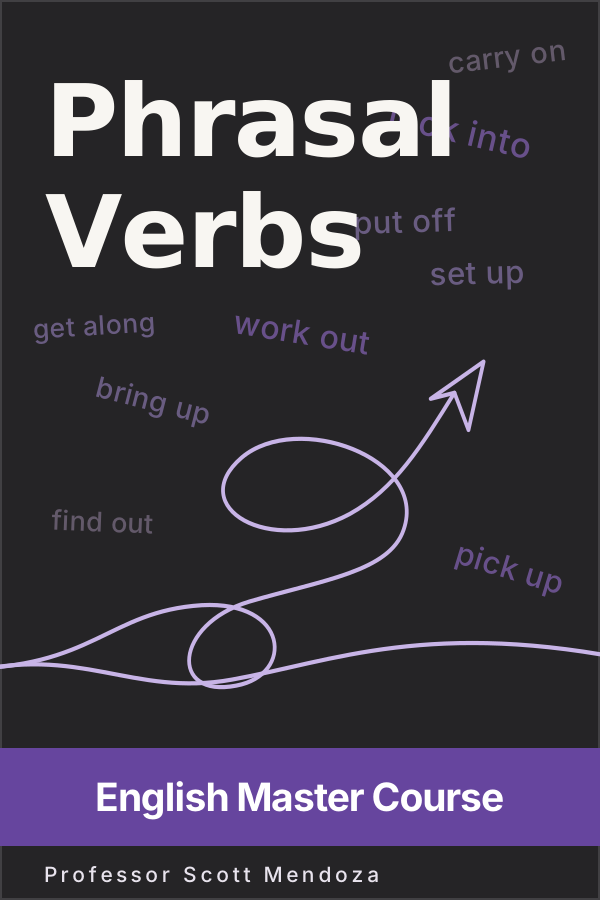
Your next step · Available on Udemy
Make more phrasal verbs part of your everyday English.
You’ve practiced postponing one plan. Build on that with 350+ useful phrasal verbs, grouped into related lessons, used in full conversations and reinforced with guided speaking practice and worksheets.
Explore the course English Master Course: Phrasal Verbs