Phrasal verbs · Free lesson
Carry out a plan: move from an idea to action
A library agrees to ask visitors about its opening hours. Volunteers ask the questions and record the answers. They have carried out the survey. Agreeing to the idea was one step; actually doing the work was another.
 Professor Scott Mendoza
Meaning in this lesson
carry out
Do the work described by a plan or task.
Example
“The volunteers carried out a library survey.”
The volunteers performed the survey at the library.
The short answer
Carry out a plan or task means do the work it calls for. “The team carried out the survey” says the team performed the survey. With a noun, carry out the survey and carry the survey out both work; with it, say carry it out.
Use carry out for performing the task.
Use carry out with a named task, plan, survey or procedure. In our scene, the survey moves from an agreed idea to real questions and recorded answers. The simple past is carried out: change the y in carry to i before adding ed. With a noun, both object positions work. A pronoun such as it belongs between the verb and out.
Keep the meaning; change the object position
The team carried out the survey.
The team carried the survey out.
The team carried it out.
“They carried out the survey” does not tell us what people answered. The survey may be complete even if its findings are not what the organizers hoped for.
Follow the plan into action
Agree on the task
The library agrees to ask visitors about opening hours.
Do the planned work
Volunteers ask the questions and record the answers.
Report that the task was performed
The volunteers have carried out the survey.
Try it now
Separate the task from its results.
Read all answers and explanations
The volunteers asked the survey questions and recorded the answers. What does “They carried out the survey” mean here?
They performed the survey by asking and recording answers.They performed the survey. Merely suggesting it is not doing it, and moving paper outside is a different use of the words.
You read only this report: “The team carried out a survey about library opening hours.” What can you conclude?
The survey took place; its findings are not stated.We know the team performed the survey. The sentence gives no findings and does not say that opening hours changed.
Replace the survey with it and use the simple past. Which sentence is correct?
The team carried it out.Use carried, not carryed, and put it between carried and out: carried it out.
Build it yourself
Report the completed survey.
Use all five pieces. Start with The team and finish with yesterday. Both positions for the noun the survey are accepted.
Build a simple-past report of the task. Select a piece again to move it back.
Your survey report
0 of 5 piecesYour chosen pieces will appear here.
See a model answer
The team carried out the survey yesterday.
Both The team carried out the survey yesterday and The team carried the survey out yesterday report the same task. With it instead of the survey, only the middle position works.
A little more clarity
Common questions
A few useful details before you move on.
Is carry out the same as carry on?
No. Carry out a task means perform it. Carry on working means continue working. One describes doing the named task; the other highlights continuation.
We carried out the survey, then carried on with our other work.
Does carry out mean the result was successful?
It can describe completing the task, but that does not guarantee the outcome someone hoped for. A completed survey can reveal an unpopular idea. State the findings separately.
We carried out the survey. Most visitors preferred the old opening hours.
Take it into your day
Carry out is about performing the task. Carry it out keeps it in the middle, and any result needs its own evidence.
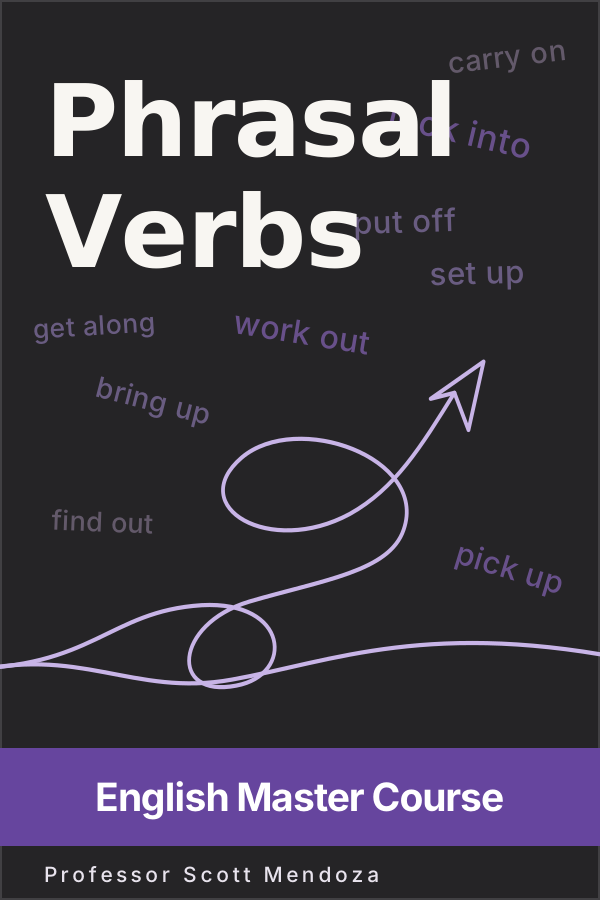
Your next step · Available on Udemy
Talk more clearly about plans and actions.
Learn 350+ useful phrasal verbs in the English Master Course for Phrasal Verbs, including carry out for putting an approved plan into action. Connect expressions with practical situations and build beyond this one task pattern.
Explore the course English Master Course: Phrasal Verbs