Grammar · Free lesson
Comparatives with than: compare two options
You are choosing how to get across town. The bus costs less, but the train takes less time. A useful comparison tells your listener which difference matters.
 Professor Scott Mendoza
Meaning in this lesson
comparative + than
A pattern that shows how one thing differs from another in a particular quality.
Example
“The train is faster than the bus, but it is more expensive.”
The train takes less time for this journey and costs more.
The short answer
Use a comparative adjective to describe a difference. Add than when you name the other option: “The train is faster than the bus.” Use faster, not more faster. With expensive, use more expensive; with good, use better.
Compare one quality at a time.
Many short adjectives use -er: cheap becomes cheaper. Many longer adjectives use more: expensive becomes more expensive. Some forms are irregular, such as good → better. Use the comparative form once, then than + the other option. Faster describes speed; it does not automatically mean better in every way.
Explain the trade-off.
The bus takes forty minutes and costs four dollars. The train takes twenty minutes and costs seven dollars.
The train is faster than the bus, but the bus is cheaper.
The comparison changes direction when you change the subject. The train is faster; the bus is cheaper.
Build a useful comparison
Choose the quality
Are you comparing price, speed or comfort?
Choose its comparative form
Cheap → cheaper. Expensive → more expensive.
Name the other option
This ticket is cheaper than that one.
Try it now
Check what you’ve learned.
Read all answers and explanations
Complete the standard comparison: “This route is ___ than the old route.”
shorterShorter is the comparative. Do not add more to shorter in this standard comparison.
Complete: “The hotel is ___ than the hostel.”
more expensiveUse more expensive. Expensive takes more for its ordinary comparative form.
For the same journey, the bus takes forty minutes and the train takes twenty. Which comparison matches those facts?
The train is faster than the bus.Twenty minutes is less time than forty. These facts describe travel time, not the price.
Put it into practice
Fix the comparison without reversing it.
The train takes less time than the bus for the same journey. Repair the sentence and keep that fact.
The train is more faster than the bus.
See a model answer
The train is faster than the bus.
A correct comparison needs the right grammar and the right relationship between the two options.
A little more clarity
Common questions
A few useful details before you move on.
Do I need than in every comparative sentence?
No. You can leave out the comparison target when it is clear from the conversation.
You try two jackets: “This one is warmer.”
Should I say better or more better?
Use better for the ordinary comparative of good. More better adds a second comparative form unnecessarily.
“The sound is better with these headphones.”
Take it into your day
Compare two real choices using one quality. If one option wins on price and the other on time, say both differences clearly.
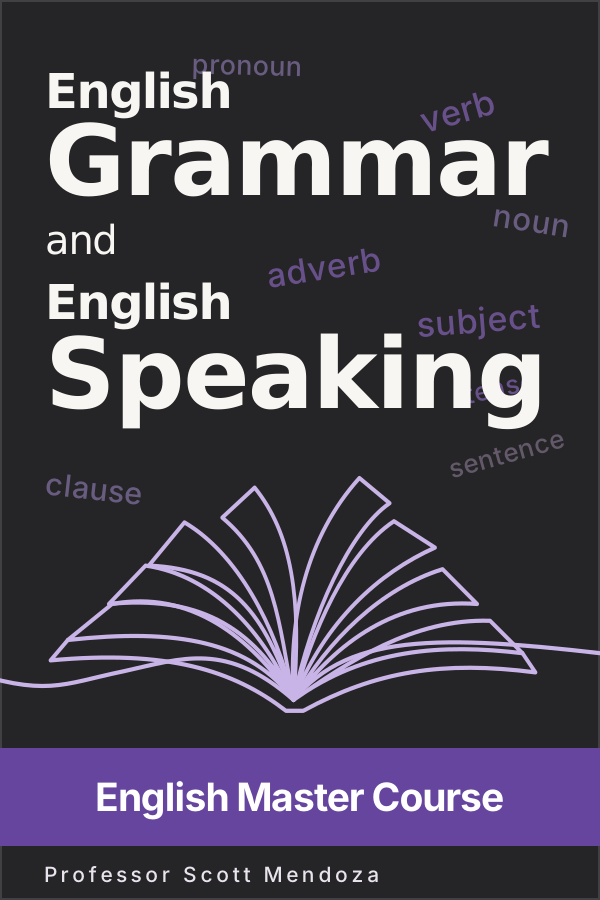
Your next step · Available on Udemy
Turn grammar patterns into useful comparisons.
You’ve compared two choices. Build a broader range of sentence patterns through the English Grammar and English Speaking course, alongside conversation examples, pronunciation and downloadable practice.
Explore the course English Master Course: English Grammar and English Speaking