Vocabulary · Free lesson
English collocations: words that work together
Words often have familiar partners. Learning the combination can make it easier to choose natural English.
 Professor Scott Mendoza
Meaning in this lesson
collocation
A pair or group of words commonly used together. Learning the combination helps you choose words that sound natural in English.
Example
“We need to make a decision today.”
We need to decide today. “Make a decision” is the useful word partnership.
The short answer
Use “make a decision” for deciding, “do your homework” for completing homework, and “heavy rain” for a lot of rain. These common word partnerships are called collocations. Practice each one in a complete sentence.
Notice more than the single word.
Collocations can take different shapes. “Make a decision” and “do your homework” use a verb with a noun phrase; “heavy rain” uses an adjective with a noun. Similar meanings do not make words interchangeable: “do a decision” is not the usual English combination. Learn a phrase in a full sentence so you can see both its word partners and how it fits the situation.
Take the phrase into a sentence.
We need to make a decision by Friday.
I usually do my homework after dinner.
The heavy rain delayed our trip.
Learning the full phrase helps you remember both the meaning and the words that commonly go together. A complete sentence also gives the phrase a purpose.
Turn a new phrase into usable English
Notice
Read or listen for the whole combination.
Understand
Check what it means in that situation.
Use
Make a sentence about something familiar.
Try it now
Find the familiar word partner.
Read all answers and explanations
“We need to ___ a decision before lunch.”
make“Make a decision” is a common combination. Here it means deciding what to do before lunch.
“I usually ___ my homework at the library.”
doUse “do” for completing homework: “do my homework.” Learn the words together as a useful phrase.
Which is the usual combination for a lot of rain?
Heavy rain.“Heavy rain” means a lot of rain falling. Word partners are not always predictable from the separate words.
Put it into practice
Find the partners. Use the phrase.
Match each word with its usual partner. Then use one of the combinations in a sentence.
See a model answer
- make a decision
Use “make a decision” when you choose what to do.
- do your homework
Use “do your homework” for completing work assigned for class.
- heavy rain
“Heavy rain” describes a lot of rain falling.
We need to make a decision about our holiday plans.
Learn these combinations as units, then give them a situation: make a decision, do your homework, heavy rain.
A little more clarity
Common questions
A few useful details before you move on.
Is there a rule for choosing “make” or “do”?
There are useful patterns: “do” often goes with tasks or activities, and “make” often goes with creating something or producing a result. These are starting points, not a rule for every phrase. Check the combination and learn it together.
“I did my homework, but I made a mistake.”
Can I change “make a decision” to “made a decision”?
Yes. The verb changes to fit the time and the subject. The word partnership stays the same. You can learn the base phrase and then use the form your sentence needs.
“We need to make a decision.” → “We made a decision yesterday.”
Are collocations and idioms the same thing?
They describe different features of a phrase. A collocation is about which words commonly go together. An idiom has an established meaning you cannot reliably work out from the individual words. “Heavy rain” is a collocation whose meaning is easy to understand; many idioms need a separate explanation.
Take it into your day
The next time you learn a word, write down one useful partner and a short example sentence.
Your next step · Available on Udemy
Put useful phrases into stronger sentences.
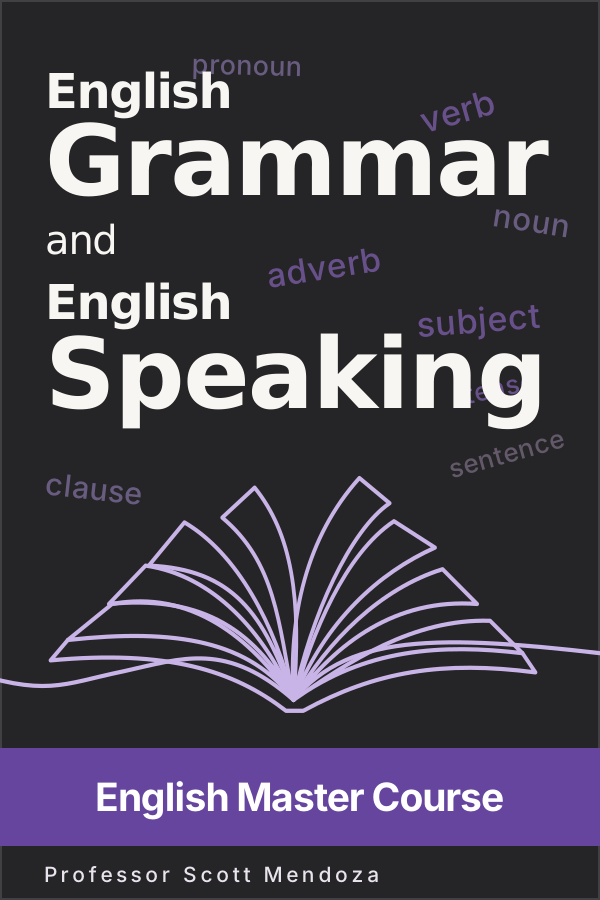
These three combinations give you a starting point. The English Grammar and English Speaking course builds the grammar, sentence structure and conversation skills around useful English, with practice that goes beyond choosing one word partner.
Explore the course English Master Course: English Grammar and English Speaking